Melanoma Disease Symptoms & Early Detection, Melanoma Removal & Treatment
Protecting families across Austral, Edmondson Park, Denham Court, Gregory hills, Carnes hill, Minto & other surrounding suburbs
The Complete Guide, Symptoms, & Life-Saving Early Detection
By The Lead Skin Cancer Specialist, Sun Smile Clinic Serving Leppington, NSW & Greater Western Sydney for More then 23 Years
What is Melanoma?
Malignant Melanoma is a type of cancer that develops from melanocytes, the pigment-producing cells in your skin that give you your tan or natural skin tone. While it is less common than Basal Cell Carcinoma (BCC) or Squamous Cell Carcinoma (SCC), melanoma is significantly more dangerous because of its ability to spread (metastatic melanoma) to other organs like the lungs, brain, and liver if not treated early.
The primary driver of this disease is DNA damage to skin cells, most often caused by exposure to Ultraviolet (UV) radiation from the Australian sun or tanning beds. This damage triggers mutations that lead the skin cells to multiply rapidly and form malignant tumors.
In 2025, our understanding of melanoma has evolved. It is no longer just about “cutting it out”; it involves understanding genetic markers like the BRAF V600E mutation and utilizing advanced dermoscopy for earlier detection than ever before.
Key Takeaway: You can have melanoma for years without knowing, or it can appear suddenly. Vigilance is your best defense.
At Sun Smile Clinic in Leppington, we teach all our patients the ABCDE Rule. This is the gold-standard guide for identifying dysplastic nevi (atypical moles) that may be transforming into melanoma.
1. A – Asymmetry If you draw a line through the middle of the mole, the two halves do not match. A benign mole is usually round and symmetrical.
2. B – Border IrregularityThe edges of an early melanoma tend to be uneven, crusty, or notched. They may look “scalloped.“
3. C – Color Variation This is a critical visual identifier. Benign moles are usually a single shade of brown. Melanoma often displays a variety of colors—different shades of brown, tan, or black. As it grows, you may see red, white, or blue (indicating inflammation or regression).
4. D – Diameter > 6mm Melanomas are usually larger in diameter than the eraser on the end of a pencil (6mm), though they can be diagnosed when they are smaller.
5. E – Evolving This is the most important factor. Any change—in size, shape, color, elevation, or another trait (like bleeding, itching, or crusting)—points to danger.
Does melanoma bleed easily? Yes. As the cancer grows, the structural integrity of the skin breaks down. Bleeding, oozing, or a sore that refuses to heal are major red flags.
Comparison: Normal Mole vs. Melanoma
| Feature | Normal Mole (Nevus) | Potential Melanoma |
|---|---|---|
| Asymmetry | Symmetrical | Asymmetrical |
| Border | Smooth, defined edges | Blurred, ragged, or notched |
| Color | Uniform (one color) | Mixed (black, brown, red, blue, white) |
| Diameter | Usually < 6 mm | Often > 6 mm |
| Evolution / Sensation | Stable over years No symptoms |
Changes over weeks/months Itchy, painful, bleeding |
Early Detection Saves Lives
📅 Need a Professional Opinion in Leppington?
Checking yourself is crucial, but expert eyes save lives. If you have noticed any of the symptoms above, do not gamble with your health.
Call Sun Smile Clinic today at +61 2 7200 8040 or book online. We serve patients from Leppington, Willowdale, Denham Court, and Emerald Hills.
The "Ugly Duckling" Sign & Nodular Melanoma
Not all melanomas follow the ABCDE rule. This is particularly true for Nodular Melanoma, an aggressive form that accounts for about 15% of cases but a large percentage of melanoma deaths.
The Ugly Duckling Sign
Most of your moles typically look like each other (your “signature” mole type). An “Ugly Duckling” is a lesion that stands out because it looks completely different from your other moles. If you have one spot that doesn’t fit the pattern, it needs to be checked immediately via dermoscopy.
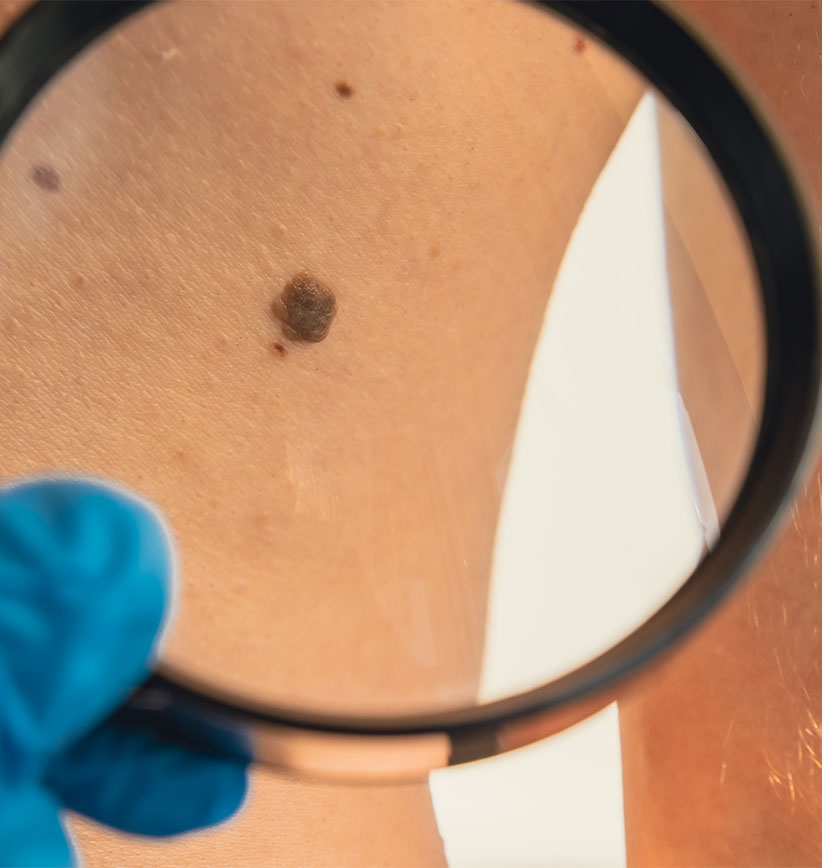
Nodular Melanoma: The Exception to the Rule
Nodular melanoma grows down into the skin (vertical growth) rather than across the surface. It is firm to the touch and typically presents with the EFG symptoms:
Elevated: Raised above the skin surface.
Firm: Feels hard to the touch (like a BB pellet under the skin).
Growing: Grows rapidly (over weeks).
Is melanoma usually itchy or painful? While many are painless, nodular melanomas may feel tender or itchy. Never ignore a firm, growing lump on the skin, even if it is pink or skin-colored (amelanotic melanoma).
Types of Melanoma: Beyond the Surface
Melanoma is not a single disease. Depending on the pathology report and cellular structure, it falls into four main categories.
1. Superficial Spreading Melanoma
This is the most common form (approx. 70%). It typically travels along the top layer of the skin for a while before penetrating deeper. It is common on the trunks of men and legs of women.
Key Sign: Irregular borders and color variation.
2. Nodular Melanoma
As mentioned, this is the most aggressive form. It lacks the “horizontal” growth phase and invades the dermis early.
Key Sign: A dome-shaped lump that may bleed.
3. Lentigo Maligna Melanoma
Common in older adults with significant sun damage, often appearing on the face, ears, or arms. It develops from a slow-growing precursor called Melanoma In Situ.
Key Sign: A large, flat, tan patch that slowly darkens.
4. Acral Lentiginous Melanoma
This is the most common form of melanoma in people with darker skin tones, though it can affect anyone. It appears on the palms of hands, soles of feet, or under the nails (Subungual Melanoma).
Key Sign: A black streak under a fingernail or a bruise on the foot that won’t heal. Bob Marley famously died from this type of melanoma.
Causes, Risk Factors & UV Radiation
What causes a normal melanocyte to turn malignant? The primary culprit is Ultraviolet (UV) radiation.
The Sun & UV Damage
Australia has one of the highest rates of melanoma in the world. UV radiation damages the DNA in skin cells. If the body cannot repair this DNA damage, mutations occur. Severe, blistering sunburns in childhood significantly increase the risk of melanoma later in life.
Genetic Factors & Heredity
Is melanoma hereditary? Yes, in about 10% of cases. If you have a first-degree relative with melanoma, your risk doubles. Genetic mutations, such as CDKN2A, can be passed down.
Additional Risk Factors
Dysplastic Nevi: Having 50+ moles or multiple atypical moles.
Skin Type: Fair skin that burns easily (Fitzpatrick types I and II).
Immunosuppression: Patients on medication that lowers immune response.
History: A previous diagnosis of basal cell or squamous cell carcinoma.
🛡️ Prevention is Better Than Cure
Living in Leppington, NSW means high UV exposure year-round. We recommend routine skin checks every 12 months for standard risk patients, and every 3–6 months for high-risk patients.Are you overdue for a check?
👉 Contact Sun Smile Clinic
Diagnosis at Sun Smile Clinic: Dermoscopy & Biopsy
At Sun Smile Clinic, we don’t just “look” at your skin; we analyze it using advanced medical technology.
1. Full Body Skin Check & Dermoscopy
We utilize high-resolution dermoscopy. A dermatoscope is a specialized handheld microscope that allows our doctors to see structures below the skin’s surface that are invisible to the naked eye. This allows us to detect Melanoma In Situ (Stage 0) long before it becomes invasive.
2. Biopsy Procedures
If a suspicious lesion is found, a biopsy is the only way to confirm a diagnosis.
Punch Biopsy: For deeper lesions.
Shave Biopsy: For raised lesions (less common for suspected melanoma).
Excisional Biopsy: The preferred method. We remove the entire mole with a small margin of safety to send to pathology.
3. The Pathology Report
The sample is analyzed by a pathologist who looks for mitotic rate (how fast cells are dividing) and ulceration. This report confirms if the spot is benign, dysplastic, or malignant.
Staging: Breslow Depth & Pathology Explained
If melanoma is confirmed, staging determines the treatment plan. The most critical factor in your pathology report is Breslow Depth (or Breslow Thickness).
What is Breslow Depth?
This measures, in millimeters, how deep the tumor has penetrated into the skin.
< 1mm: Thin melanoma (High cure rate, usually requires only wide local excision).
1mm – 4mm: Intermediate thickness (May require Sentinel Lymph Node Biopsy).
> 4mm: Thick melanoma (Higher risk of metastasis).
The Staging System (Stage 0 – IV)
| Stage | Description | 5-Year Survival Rate* |
|---|---|---|
| Stage 0 | Melanoma In Situ. Confined to the epidermis. 100% curable with excision. | ~99% |
| Stage I | Tumor is thin (<2mm) and has not spread. No ulceration. | ~98% |
| Stage II | Tumor is thicker (>2mm) or ulcerated, but has not spread to lymph nodes. | 80–90% |
| Stage III | Spread to nearby lymph nodes. Requires advanced treatment. | 60–70% |
| Stage IV | Metastatic Melanoma. Spread to distant organs (lung, liver, brain). | Varies significantly |
Survival rates are estimates based on 2025 data and vary by individual biology and treatment response.
Treatment Options in 2025: Surgery to Immunotherapy
Medicine has advanced rapidly. At Sun Smile Clinic, we coordinate end-to-end care, from surgical removal to referrals for advanced oncology if required.
- Wide Local Excision (Surgery)
For early-stage melanoma, surgery is often the only treatment needed. We remove the tumor site with a “safety margin” of healthy skin to ensure no cancer cells remain.
- Sentinel Lymph Node Biopsy (SLNB)
For melanomas deeper than 1mm, we may recommend an SLNB to check if cancer cells have traveled to the nearest lymph node.
- Immunotherapy (The New Standard)
In 2025, Immunotherapy has revolutionized survival rates for Stage III and IV melanoma. Drugs known as Checkpoint Inhibitors (targeting PD-1 or CTLA-4) help your own immune system recognize and attack cancer cells.
- Common agents: Pembrolizumab (Keytruda), Nivolumab (Opdivo).
- Targeted Therapy
If your melanoma tests positive for the BRAF mutation (found in ~50% of melanomas), we can use targeted drugs (BRAF and MEK inhibitors) to block the signals that cause cancer cell growth.
- Radiation & Chemotherapy
Radiation therapy is occasionally used as an adjuvant therapy after surgery. Traditional chemotherapy is now rarely used as a first-line treatment due to the superior efficacy of immunotherapy.
Why Choose Sun Smile Clinic Over Everyone Else?
When it comes to skin checks and skin cancer treatment in NSW, you have a choice. Ensure your skin is in the hands of a dedicated Skin Cancer Specialist. Discover why Sun Smile Clinic is the trusted partner for thousands of local families.
23+ Years of Clinical Excellence:
We aren't a pop-up cosmetic clinic. We are a dedicated medical facility with over two decades of experience in skin cancer medicine.
Advanced Diagnostic Tech:
We use the latest digital dermoscopy and mapping tools to track changes over time, catching "evolving" moles that others miss.
End-to-End Care:
From the initial check to the biopsy and pathology coordination, through to surgical treatment and excision, we handle it all in our Leppington facility.
High-Risk Patient Management:
We specialize in patients with a history of melanoma, offering rigorous follow-up protocols.
Local Trust:
We have treated thousands of families from Denham Court, Gregory Hills, Austral, Leppington, Preston, Carnes Hill, Mount Annan, Minto, Ingleburn, Oran Park, Edmonson Park and Bardia
Honest, Accessible, and Transparent Pricing:
We believe healthcare should be accessible to all. We provide clear costs for skin checks and procedures upfront.
-
Bulk Billing Available: We proudly offer bulk billing for eligible patients with a valid Medicare card for many common skin check consultations, meaning zero out-of-pocket costs for you.
-
No Hidden Fees: We provide clear, transparent quotes for procedures (like biopsies or excisions) that are not fully bulk billed, so you know the cost before any treatment begins.
-
Accessibility for Local Families: This commitment ensures that vital early detection checks are affordable for families across Leppington, Denham Court, and the surrounding suburbs, eliminating the financial barrier to peace of mind.
Our Guarantee: We treat every spot seriously. We do not rush appointments. We take the time to explain your pathology report in plain English so you have total peace of mind.
Frequently Asked Questions (FAQ)
What are the very first signs of melanoma?
The first sign is usually a new mole or a change in an existing mole. Look for the ABCDEs: Asymmetry, Border irregularity, Color changes, Diameter growth, or Evolving characteristics.
Is melanoma 100% curable?
If caught in Stage 0 (In Situ) or early Stage 1, melanoma is almost 100% curable via surgical excision. Survival rates drop significantly once the cancer metastasizes, which is why early detection is non-negotiable.
Can you have melanoma for years without knowing?
If caught in Stage 0 (In Situ) or early Stage 1, melanoma is almost 100% curable via surgical excision. Survival rates drop significantly once the cancer metastasizes, which is why early detection is non-negotiable.
How fast does melanoma spread?
It varies by type. Nodular melanoma is notorious for spreading rapidly (within months). Superficial spreading melanoma may stay on the skin’s surface for years before diving deeper.
Is melanoma itchy or painful?
Often, it is neither. However, some patients report a persistent itch, tenderness, or a feeling of “awareness” of a specific mole. Pain is usually associated with deeper or ulcerated lesions.
Can a normal mole turn into melanoma?
Yes. While many melanomas arise as new spots (de novo), roughly 20–30% of melanomas develop from existing moles. This is why tracking changes is vital.
What happens if melanoma goes untreated?
Untreated melanoma will eventually grow deep enough to reach blood vessels and lymphatics. From there, it spreads to the lymph nodes, lungs, liver, and brain. Stage IV melanoma is life-threatening.
Can blood tests detect melanoma?
Currently, there is no standard blood test for diagnosing early melanoma; a biopsy is required. However, for advanced stages, blood tests (like LDH levels) and ctDNA (circulating tumor DNA) are used to monitor the disease and treatment response.
Can you scratch off a melanoma?
No. If you scratch a melanoma, it may bleed and scab, but the cancer cells remain in the skin and will continue to grow. You cannot “remove” cancer at home.
How common is melanoma in 2025?
Melanoma remains the third most common cancer in Australia. Australia and New Zealand have the highest melanoma rates in the world due to our UV levels and outdoor lifestyle.
Is Stage 4 melanoma terminal in 2025?
Not necessarily. While historically the prognosis was poor, modern immunotherapy and targeted therapies have turned Stage 4 melanoma into a manageable chronic condition for many patients, with some achieving complete remission.
Does melanoma blanch when pressed?
No. Unlike some rashes or vascular lesions which turn white (blanch) when pressed, melanoma typically does not blanch because the pigment is inside the cells.
How do you check yourself for melanoma?
Stand in front of a full-length mirror. Check your front, back, and sides. Raise your arms. Use a hand mirror to check your back, neck, and scalp. Don’t forget soles of feet, between toes, and under nails.
What is the difference between basal cell and melanoma?
Basal Cell Carcinoma (BCC) is common, slow-growing, pearly/pink, and rarely spreads. Melanoma is darker, irregular, faster-growing, and has a high risk of spreading to other organs.
Can melanoma appear suddenly?
Yes. De novo melanomas (new spots) can appear suddenly on normal skin. This is actually more common than a melanoma growing from an old mole.